
New Publication in Cell Chemical Biology
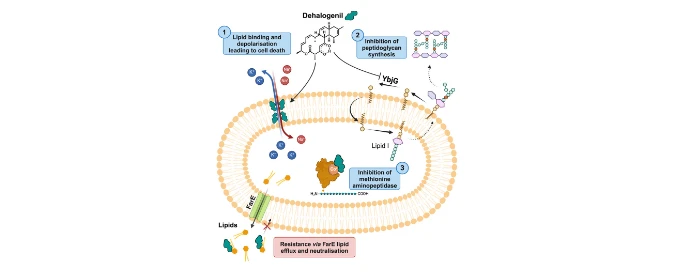
Antimicrobial resistance is a threat to human health rendering current first-line antibiotics ineffective. New agents overcoming resistance mechanisms are urgently needed to guarantee successful treatment of human disease in the future. Chlorotonils, a natural product class with yet unknown mode of action, were shown to have broad-spectrum activity against multi-resistant Gram-positive bacteria and the malaria parasite Plasmodium falciparum, with promising activity and safety in murine infection models. Here, we report that chlorotonils can target the cell membrane, cell wall, and protein biosynthesis. They can be characterized by a rapid onset of action via interference with ion homeostasis leading to membrane depolarization, however, without inducing severe barrier failure or cellular lysis. Further characterization confirmed binding of chlorotonils to bacterial membrane lipids eventually leading to uncontrolled potassium transport. Additionally, we identified functional inhibition of the peptidoglycan biosynthesis protein YbjG and methionine aminopeptidase MetAP as secondary targets of chlorotonils.
Deschner, F., Mostert, D., Daniel, J.-M., Voltz, A., Schneider, D. C., Khangholi, N., Bartel, J., Pessanha de Carvalho, L., Brauer, M., Gorelik, T. E., Kleeberg, C., Risch, T., Haeckl, F. P. J., Herraiz Benítez, L., Andreas, A., Kany, A. M., Jézéquel, G., Hofer, W., Müsken, M., Held, J., Bischoff, M., Seemann, R., Brötz-Oesterhelt, H., Schneider, T., Sieber, S., Müller, R. & Herrmann, J. “Natural products chlorotonils exert a complex antibacterial mechanism and address multiple targets”, Cell Chemical Biology, 32(4), 586-602.e15 (2025).
Link: https://doi.org/10.1016/j.chembiol.2025.03.005
This reprint is liscensed under CC BY 4.0